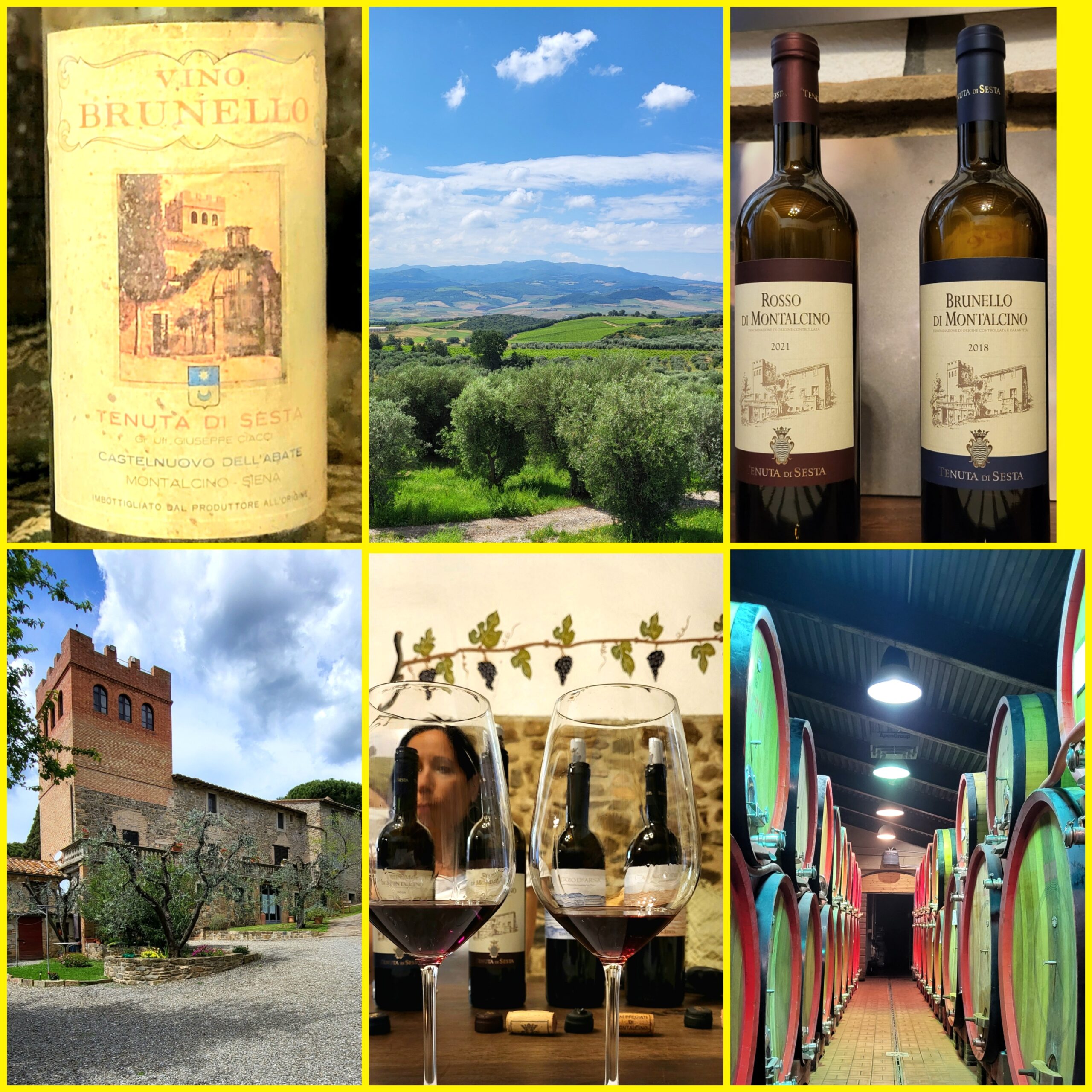
Tenuta di Sesta: History, Terroir and Identity in Southern Montalcino
From the Tolomei estates to the Ciacci family: continuity and transformation in the heart of Val d’Orcia
Passion lies at the core of every winery—passion for the land, for nature, and for wine itself.
Yet in Montalcino, no estate can be understood without its history, often rooted deep in the Middle Ages.
Centuries pass. Ownership changes. The land remains—silent, waiting for the right moment.
Historical origins: the Tolomei family
The story of Tenuta di Sesta unfolds within a broader historical framework, linked to the Tolomei family, one of Siena’s most influential noble dynasties.
Their estates extended across Montalcino and Val d’Orcia, particularly along the Orcia River. Today, parts of these lands belong to well-known wineries such as Argiano, Poggio alle Mura (now Castello Banfi), and Col d’Orcia.
The transition to the Ciacci family
By the mid-19th century, portions of these lands passed to the Ciacci family, originally from Castelnuovo dell’Abate.
Felice and Giovanni Ciacci began working at Tenuta di Sesta, while Dino Ciacci acquired the Mocali estate from the Count of Argiano. Dino later became one of the founding members of the Brunello di Montalcino Consortium.
Over time, the Ciacci family established several estates in southern Montalcino. The current structure of Tenuta di Sesta dates to 1995, when the estate was divided between Giovanni and Giovanna Ciacci, heirs of Giuseppe Ciacci.
Today, the estate is run by Giovanni Ciacci together with his children, Andrea and Francesca.
From sharecropping to the modern identity of Brunello
The evolution of the estate reflects a broader transformation across Montalcino.
In the 1960s, the end of the sharecropping system led to a redistribution of land ownership, giving rise to a new generation of producers. Alongside historic families, they played a key role in shaping Brunello’s modern identity.
Tenuta di Sesta was among the 12 founding estates of the Brunello di Montalcino DOC in 1966. The estate still preserves one of its earliest bottles.
Terroir: a mosaic of soils and microclimates
The vineyards extend along the southern slope of Montalcino, between the Abbey of Sant’Antimo and the Orcia River, covering around 30 hectares.
The soils, of Eocene origin, are predominantly stony, with galestro and palombino components. Even over short distances, the composition shifts, creating a mosaic of micro-terroirs that requires careful, site-specific management.
Mount Amiata offers natural protection from harsh weather, while breezes from the Maremma help moderate summer temperatures, preserving both acidity and aromatic expression.
Vineyards and vineyard management
The estate includes several key parcels:
- Sesta, the oldest vineyard, contributing structure and longevity
- Pian di Sesta, enhancing fruit and body
- Duelecci, the estate’s cru, divided into eastern and western exposures
- Costa di Monte, at higher altitude, producing more elegant and floral wines
- Vigna di Sotto, dedicated to Rosso di Montalcino
Planting density averages around 5,000 vines per hectare, trained using spur cordon.
Harvesting is carried out parcel by parcel, according to ripeness.
Winemaking and style
Fermentation takes place in temperature-controlled stainless steel tanks.
Aging is mainly in large Slavonian oak casks (around 30 hl) for 30 to 36 months.
The winery is designed to allow gravity flow, minimizing mechanical stress on the wine.
The approach combines modern agronomic knowledge with a clear commitment to traditional expression.
A distinctive varietal choice
One of the estate’s more distinctive decisions is the cultivation of Cabernet Franc instead of the more common Cabernet Sauvignon.
Cabernet Franc brings freshness, elegance, and subtle spice—black pepper and licorice—integrating harmoniously with Sangiovese and Merlot in Poggio d’Arna Toscana IGT.
Tasting: Brunello di Montalcino 2012
Deep ruby in color.
On the nose, notes of sour cherry, plum, undergrowth, mushroom, tobacco, and aromatic herbs emerge, with balsamic nuances and hints of rosemary.
On the palate, the wine is warm and balanced, with velvety tannins and solid structure.
The 2012 vintage, shaped by warm and dry conditions, produced wines of depth, balance, and aging potential.
Wines from Tenuta di Sesta often show an initial restraint, gradually opening over time to reveal greater complexity and expression.
Conclusion
Tenuta di Sesta stands as a quiet but compelling expression of Montalcino.
A place where history, landscape, and knowledge converge—and where the voice of terroir remains central.