The Pacenti Family: One Root, Three Wineries, Three Styles
One family, three relatives, three distinct wineries.
The differences in vineyard management across the three estates reflect clearly defined agronomic approaches, each consistent with the producer’s philosophy: from rigorous classicism to cutting-edge innovation.
- Canalicchio di Sopra – Scientific precision in service of the cru
Vineyard management at Canalicchio di Sopra is based on detailed scientific zoning.
Soil analysis, vigour mapping, and chemical studies allow for tailored interventions between the clay-rich soils of Canalicchio and the galestro soils of Montosoli.
Agronomic practices—pruning, leaf thinning, canopy management—are customized for each individual parcel, with the aim of enhancing the expression of each cru.
Great attention is given to biodiversity and the natural balance of the soil, avoiding chemical forcing.
The Ripaccioli brothers have predominantly chosen the Guyot training system, especially in Montosoli.
This system, which involves the annual renewal of the fruiting cane, allows for balanced canopy management while protecting the grapes from direct sunlight. It is now considered one of the most suitable systems to mitigate the effects of climate change, helping to produce fresher, less extracted wines.
In the cellar, stainless steel and traditional concrete vats are used.
Aging is carried out separately by parcel: wines from clay soils and those from galestro are not blended immediately, but instead mature independently.
The result is Brunello wines that are mineral, long-lived, and marked by pronounced salinity and elegance.
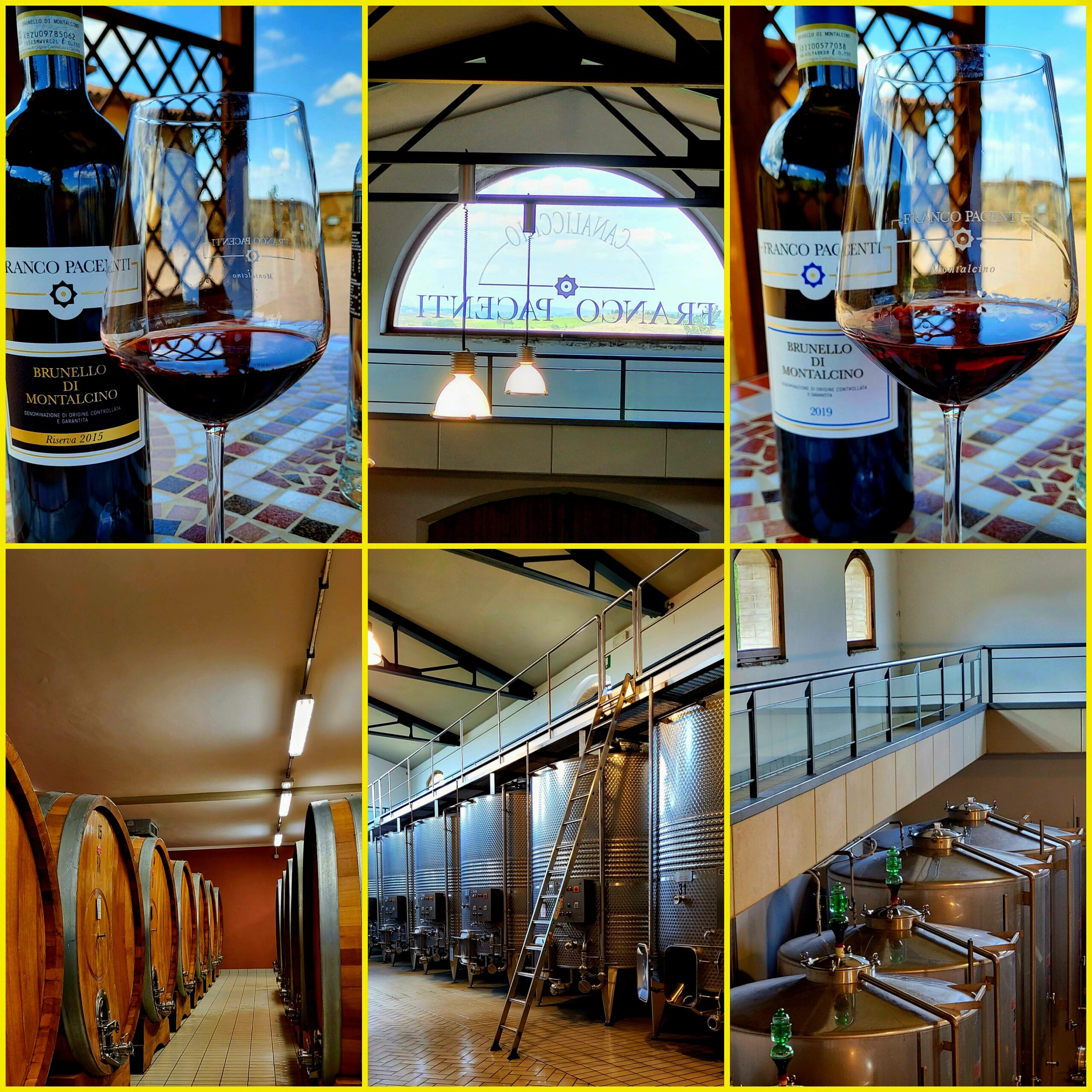
- Franco Pacenti – Tradition and respect for natural rhythms
Vineyard management at Franco Pacenti follows a philosophy rooted in tradition and respect for natural cycles, aiming to grow vines with minimal stress.
Canopy management plays a crucial role in ensuring slow and steady grape ripening.
All vineyard operations are carried out strictly by hand.
The training system used is unilateral cordon spur pruning, which yields wines typical of the north-eastern slope of Montalcino: Brunello of great finesse and elegance.
In the cellar, fermentation takes place in stainless steel tanks, while aging occurs exclusively in traditional large oak casks (30–50 hectoliters).
Large casks allow for slow, gradual maturation thanks to a lower surface-to-volume ratio.
The result is a Brunello that preserves the purity of the fruit, with classic notes of cherry and violet—an authentic expression of the territory.
- Siro Pacenti – Extreme density and modern technology
Siro Pacenti stands out for a strongly innovative approach, combining bold agronomic choices with advanced cellar technology.
The main training system is bilateral cordon spur pruning at very high density (6,000–7,000 vines per hectare).
The presence of two horizontal arms encourages intense root competition, leading the vine to produce fewer clusters per plant, but with a high concentration of polyphenols and sugars.
The small berries are ideal for aging in barrique.
The old vineyards in Pelagrilli are managed with extreme care, with very low yields to preserve concentration and complexity.
Alongside cordon spur pruning, some new plantings also adopt bush vines (alberello), a choice driven largely by climate change: this form creates a natural “umbrella” that protects the grapes from direct sunlight, reducing heat stress.
Unlike the other two estates, Siro Pacenti works across two climatically contrasting areas:
- Pelagrilli (north): cooler, clay-rich soils
- Piancornello (south): warmer, more mineral soils
Harvest timing is carefully staggered to balance acidity and power.
Extensive clonal selection of Sangiovese has led to the identification of the most suitable varieties for each soil type, favoring small berries with thick skins.
In the cellar, fermentation takes place in a combination of stainless steel and modern concrete vats (tulip- or egg-shaped), ensuring slow, stable fermentations while preserving the aromatic purity of Sangiovese.
Aging continues in French oak barriques, often new. Before bottling, the wine is transferred back into concrete for natural settling and final harmonization, without further influence from wood.
The modern technology adopted by Giancarlo Pacenti allows for Brunello wines that are powerful thanks to barrique aging, yet at the same time precise, vibrant, and expressive thanks to the use of concrete.
Conclusion
Three wineries, three different visions, one great interpreter: Sangiovese from Montalcino.
From the scientific precision of Canalicchio di Sopra, to the traditional rigor of Franco Pacenti, to the technological and agronomic research of Siro Pacenti, what emerges is a narrative shaped by conscious choices and a balance between nature and human intervention.
These differences do not divide—they enrich the territory.
Each approach contributes to building the complex and fascinating identity of Montalcino, demonstrating that there is no single way to make Brunello, but many possible paths to excellence.
In this continuous dialogue between past and future, vineyard and cellar, the true protagonist remains the same: time.
And it is time that transforms these philosophies into wines capable of telling, bottle after bottle, the living story of Montalcino.