There are vineyards that simply produce wine. And then there are vineyards that have helped write the history of Brunello di Montalcino.
Le Chiuse belongs to the second category.
The story of this estate is deeply connected to the legendary Biondi Santi family, the pioneers of Brunello di Montalcino.
The property became part of the family holdings at the end of the 18th century, following the marriage between Maria Tamanti and Clemente Santi. For decades, the grapes from these vineyards were used to produce the famous Brunello di Montalcino Riserva at Tenuta Il Greppo.
After the death of Tancredi Biondi Santi, ownership of Le Chiuse passed to his daughter Fiorella, while her brother Franco Biondi Santi became the owner of Il Greppo. Between the two siblings there was not only a family bond, but also a strong professional collaboration.
Until 1990, the grapes from Le Chiuse continued to contribute to the production of the prestigious Biondi Santi Riserva.
In 1986 the estate passed to Fiorella’s daughter, Simonetta Valiani. When the lease agreement came to an end, Simonetta decided to take over the management of the estate together with her husband, opening a new chapter in the history of Le Chiuse.
Today the estate covers about 8 hectares of vineyards planted exclusively with Sangiovese Grosso, clone BS11 (Brunello Biondi Santi 11), the first vine clone officially registered in the Italian National Register of Vine Varieties in 1978.
Le Chiuse is located on the north-eastern side of Montalcino, in the area known as Sferracavallo.
An unusual name, but a rather appropriate one: the road leading up to the estate is steep enough that every time I drive there, it almost feels as if the car is struggling along with me.
According to Lorenzo Magnelli, this site could be described as having a “ninth solar exposure”.
The vineyards facing east, touched by the first light of the morning, tend to produce fresher and more delicate grapes, often destined for Rosso di Montalcino. The softer morning light helps preserve acidity and more subtle floral and fruity aromas.
The vineyards facing west, on the other hand, benefit from the warmer and more intense afternoon sun. Here the grapes reach a fuller ripeness and higher sugar concentration, making them ideal for Brunello.
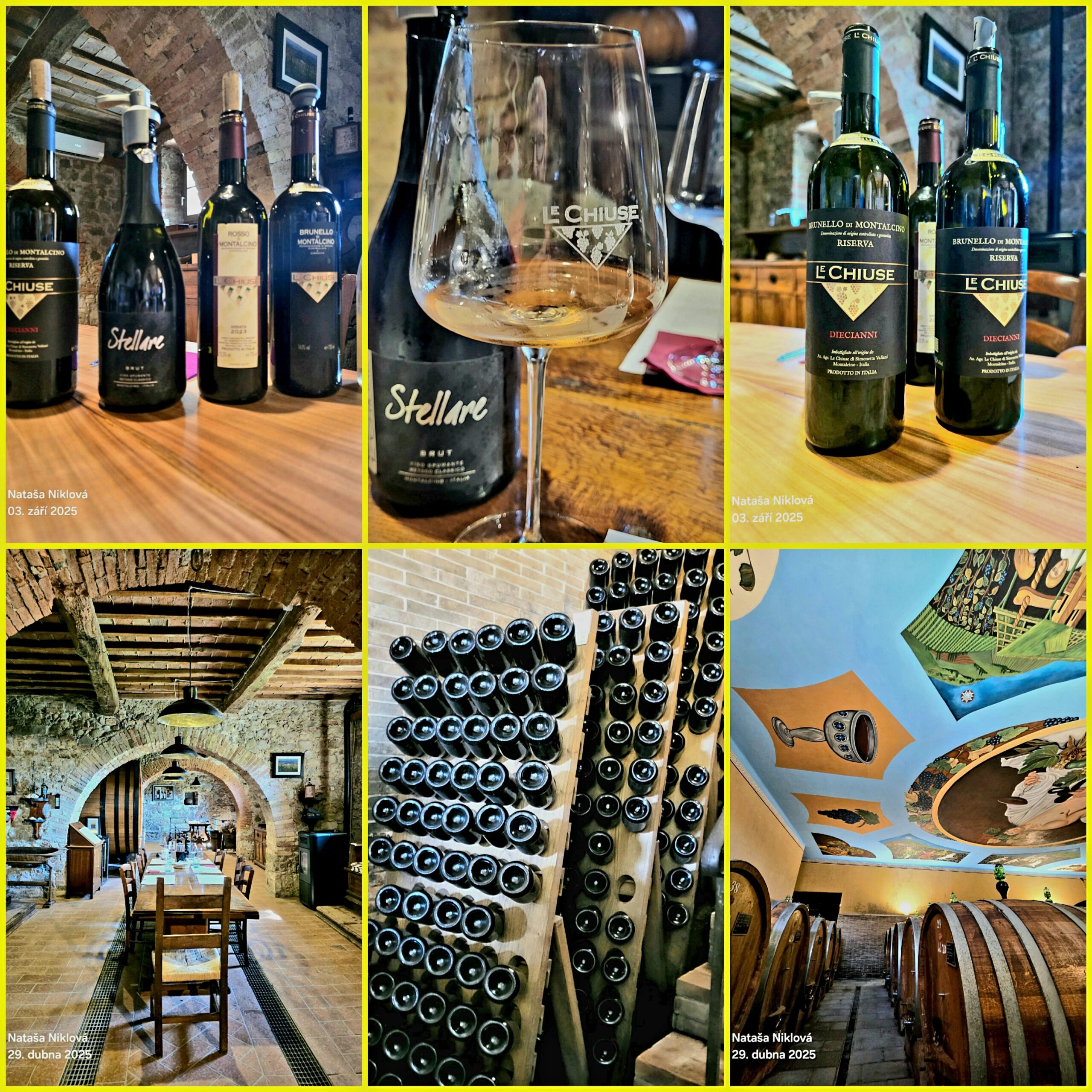
Stepping into the aging cellar, the first thing that catches the eye is a reproduction of Caravaggio’s famous Bacchus.
It is often said that a cellar is not just a place where wine ages, but a space with its own atmosphere. Some cellars resemble silent cathedrals, with carefully designed lighting and music playing softly in the background. Others tell stories of centuries past, located in truly historic places.
At Le Chiuse, the cellar becomes something else again: a meeting point between wine and art. Alongside Bacchus, other mythological figures decorate the space, creating a timeless and almost theatrical atmosphere.
Another surprise awaits in the cellar: pupitres used for the remuage process.
It is not something one immediately expects in an estate known for a wine called Diecianni — “ten years”.
Yet tasting the wines reveals that at Le Chiuse they are capable of combining the character of Sangiovese Grosso with the freshness of sparkling wine.
Their Metodo Classico Stellare, produced from 100% Sangiovese, ages on the lees for at least 24 to 30 months. The result is a refined sparkling wine with beautiful minerality, finesse and a fresh, fruit-driven character.
Naturally, the heart of the estate remains Brunello di Montalcino, and in particular the Brunello di Montalcino Riserva Diecianni.
This wine perfectly represents the elegant style of the north-eastern side of Montalcino: precise, refined and remarkably vibrant even after long aging.
In the glass it reveals aromas of morello cherry and ripe cherry, followed by notes of forest floor and a delicate hint of tobacco.
During my visit I had the opportunity to taste the Brunello di Montalcino Riserva Diecianni 2016 — a wine that is both refined and complex, and a beautiful expression of this historic terroir.
By the end of the visit, one is left with the feeling that Le Chiuse is more than just a winery. It is a place where the history of Brunello continues to live and evolve.
Here the past is not simply remembered; it forms the foundation on which the present is built.
Between vineyards bathed in the light of dawn and sunset, and among the silent casks of the cellar, Sangiovese continues to tell a story that began more than two centuries ago.
A story that still finds one of its most elegant expressions in the glass of Brunello di Montalcino Riserva Diecianni.